Conversation


Adds Automated Access (docs/using-source/automated-access.md), the guide for software that reaches Source Cooperative with nobody at the keyboard: what a service account is; creating one and granting it products; issuing an API key and the five variables the AWS CLI or an SDK needs to exchange it at the data proxy; the refusal users see and the request id to quote; keeping the key out of URLs and debug output; rotation and editable expiry; tools that keep their first credentials; GDAL; revocation, the emergency stop and revoking a found key; and GitHub Actions as coming soon. The page is added to sidebars.ts.

Upload Your Data's Option 3 walked through trusting an IAM role in the uploader's own AWS account to write straight to Source's bucket. Service accounts supersede it, so the section is now a pointer to the new page, as are the two references to it earlier on that page and the "contact us" line for automated access. Access Data gains one sentence pointing unattended software at service accounts.

Co-Authored-By: Claude Opus 5.5 <noreply@anthropic.com>
Claude-Session: https://claude.ai/code/session_01R1eiTse4416N6uTgAy4Ddd

|
The latest updates on your projects. Learn more about Vercel for GitHub.
|



alukach
added a commit
to source-cooperative/source.coop
that referenced
this pull request
Sep 29, 2026

…accounts (#570) Closes #548. Closes #546. API keys are the second Integration type beside the GitHub trusts #567 shipped, and #566 replaced proof of control with per-account trust. The `source.coop` half of #548. Part of #491. **Merge order:** this can merge and deploy before the proxy. It no longer calls the proxy; the proxy calls it. source-cooperative/data.source.coop#235 is the proxy half and needs the route here to be live, or every key exchange fails closed. ## What API keys for environments without OIDC — a server, a scheduler, an instrument — per ADR-013 as revised in source-cooperative/data.source.coop#234: **a key is an opaque secret that source.coop resolves by hash; nothing signs it.** Six commits on `main`: the original feature, dropping the Ory-id guard once #567 namespaced service-account ids, #580's rework to opaque keys, the key hint, a calmer key list, and that list as its own component with stories. **The key** is `sck_` + 32 random bytes in base64url: a fixed 47 characters, all entropy after the prefix, matching `sck_[A-Za-z0-9_-]{43}`, which is what gets registered with secret scanners (#561). It is shown once and never stored. **The record** (`service-account-keys` table) is keyed by the key's hex SHA-256, with a public `key_id` (a UUID) for listing, revoking and changing expiry, a label, who issued it and when, an optional expiry, `revoked_at` and `last_used_at`. `publicKey()` strips the hash before any record reaches a client component. **The hint**: the record also keeps the key's last four characters, and the key list shows each key as `sck_…Xy9Q`, so someone holding a key can tell which record, and so which service account, it is. Four characters are 24 of the key's 256 random bits, leaving far too many to guess. The hint only confirms a key in hand against its record; it is never used to look a key up, since keys across the platform will share it. The issue dialog says how the new key will be listed. Keys issued before the hint existed are listed without one. **Issuing** (`issueApiKey`): whoever manages the service account gives a label and an expiry (30/90/365 days, or never). The action generates the key, writes the record and returns the key once. A disabled service account is refused. **Revoking** sets `revoked_at`; **expiry** can be changed after issuance, including to never. **Exchanging**: `POST /api/v1/service-account-keys/exchanges` with `{key_hash}` is what the proxy calls at `/.sts` when a key is presented, authenticated as the proxy itself (`verifyProxyAssertion`, sentinel subject `urn:source:data-proxy`, recorded in the ADR-005 amendment in source-cooperative/data.source.coop#234). It always answers 200 with `{account_id, key_id, active}`. `active` means known, not revoked, not expired, and its service account not disabled; an unknown hash is answered as inactive, indistinguishable from a revoked one. It records last use. The proxy caches the answer for 60s, so revocation takes effect for new exchanges within that time; credentials already issued live to their session cap. **Resolving the subject**: after an exchange, the proxy's credentials name the service account itself, and `authenticateWithOidcToken` resolves it with `fetchByOryId`, then a service account by id. No service account's id can be someone's Ory identity id: #567 namespaces it as `{owner}--{id}`, and a UUID never contains `--`. **UI**: the service account's page (#567's `ServiceAccountDetail`) has an API keys section, rendered by `ApiKeyList`, a row per key. On the left, the label with a Revoked or Expired marker, and the key's hint beneath. On the right, two short lines: how it has been used ("Used 3 days ago", "Never used") and when it ends ("Expires in 5 months", "Never expires", "Revoked 9 months ago"). The exact dates, and who issued the key and when, are in their tooltip. Change expiry and Revoke are in a "⋯" menu; a revoked key has none, and keeps an invisible copy of the button so its lines align. The section header carries `IssueApiKeyDialog`, which shows the key once with a copy button, and the environment variables that point any AWS SDK or the AWS CLI at the proxy. The list row counts live keys as a way to sign in. 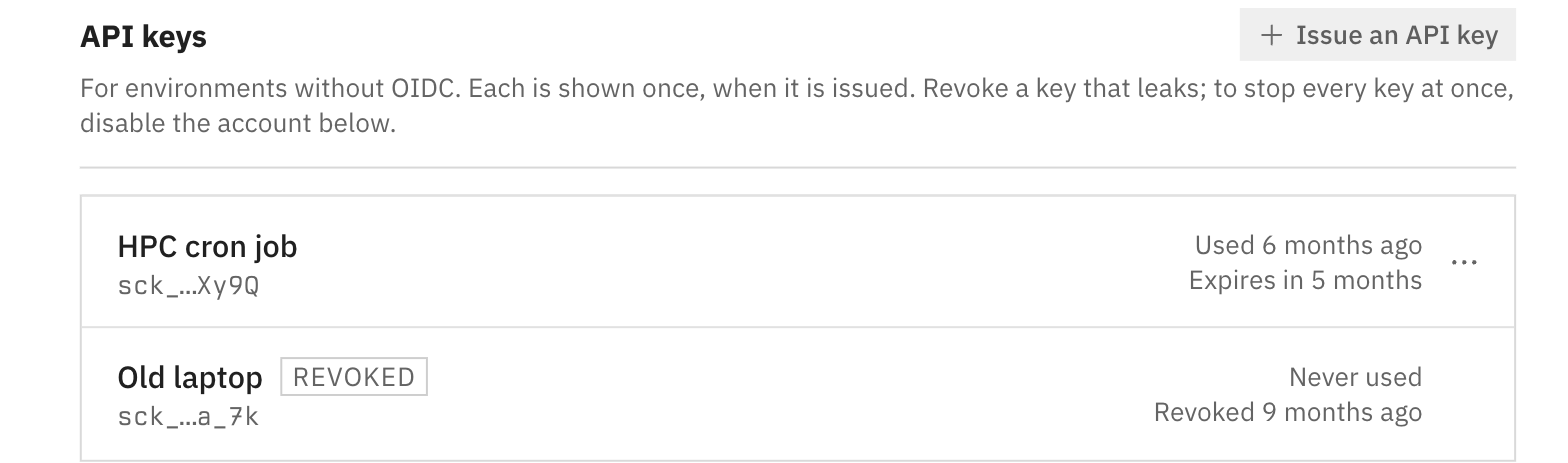 Every state a key can be in, from `ApiKeyList`'s Default story: 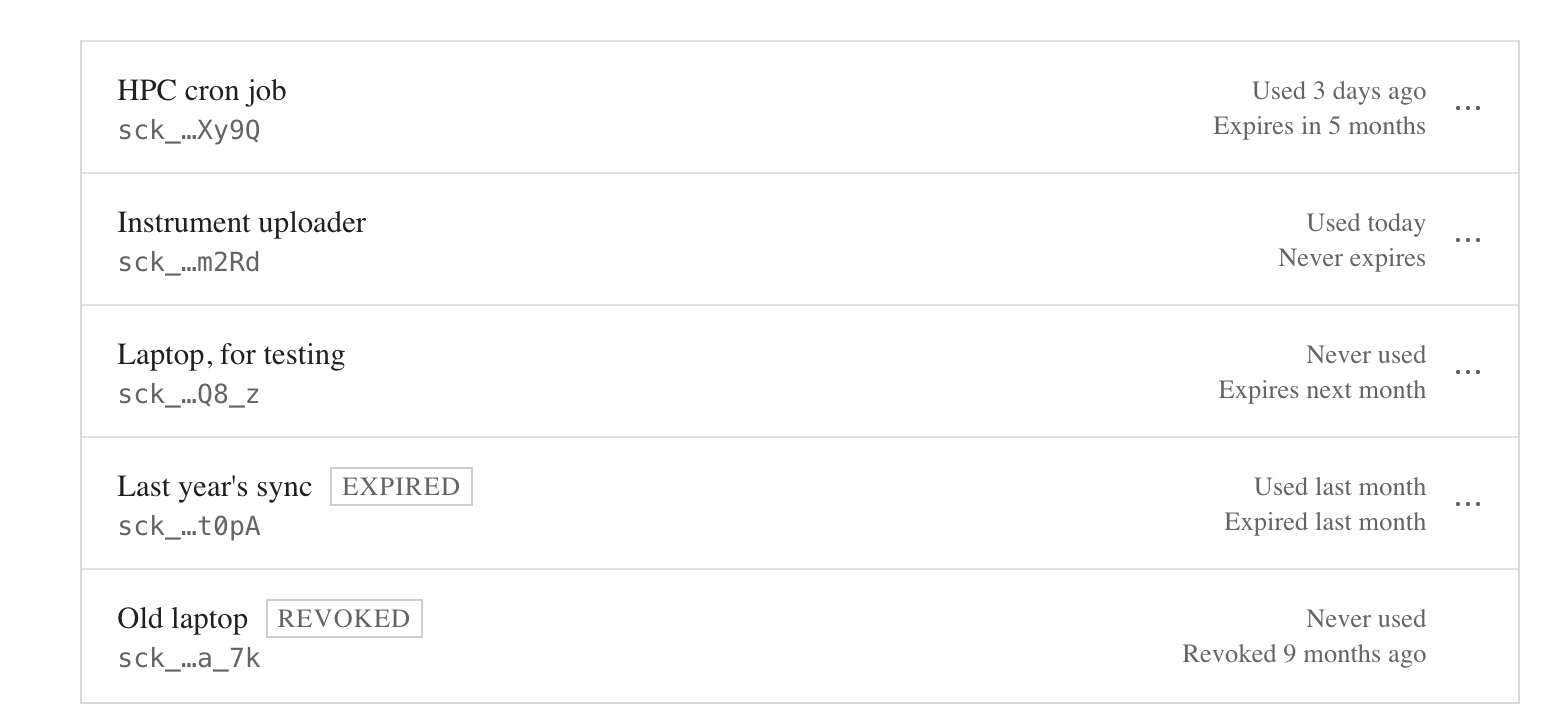 ## Stories - `ApiKeyList` › **Default** (every key state), **Single**, **WithoutHint**, **Empty** — https://source-coop-ui-git-feat-service-account-keys-radiantearth.vercel.app/?path=/story/features-service-accounts-apikeylist--default (dates are set relative to today; hover a row's dates for the exact ones) - `ServiceAccountDetail` › **Default** — https://source-coop-ui-git-feat-service-account-keys-radiantearth.vercel.app/?path=/story/features-service-accounts-serviceaccountdetail--default - `ServiceAccountList` › **Default** — https://source-coop-ui-git-feat-service-account-keys-radiantearth.vercel.app/?path=/story/features-service-accounts-serviceaccountlist--default - `IssueApiKeyDialog` › **Default** — https://source-coop-ui-git-feat-service-account-keys-radiantearth.vercel.app/?path=/story/features-service-accounts-issueapikeydialog--default (submitting reaches the show-once view with the hint line) - `ApiKeyExpiryField` — https://source-coop-ui-git-feat-service-account-keys-radiantearth.vercel.app/?path=/story/features-service-accounts-apikeyexpiryfield--default ## Testing - `npx jest` — 79 suites, 835 tests, all pass on the branch as rebased onto `main`. `service-account-keys.test.ts` covers issuing (the record holds the hash, never the key; the hint is the key's last four characters; the key is returned once), no-expiry keys, refusals before any write, revoking only own keys, and expiry changes including to never. The exchanges route test covers the proxy-only auth, active and inactive answers, and last-use recording. - `npm run type-check`, `next lint`, `npm run build-storybook` — clean. ## Docs and ADRs data.source.coop: this implements ADR-013 as revised in source-cooperative/data.source.coop#234, with ADR-014 from source-cooperative/data.source.coop#232; the proxy side is source-cooperative/data.source.coop#235, which supersedes source-cooperative/data.source.coop#233. The hint is a display detail the ADR doesn't need. docs.source.coop: the unattended-workflow guide, source-cooperative/docs.source.coop#37 for source-cooperative/docs.source.coop#34, should mention matching a key to its account by its last four characters. 🤖 Generated with [Claude Code](https://claude.com/claude-code) --------- Co-authored-by: Claude Fable 5.1 <noreply@anthropic.com>
An API key now ends in a six-character checksum of the rest (ADR-013, source-cooperative/data.source.coop#242), so the data proxy and the Source CLI refuse a key that was cut short or mistyped before anything is looked up, with "API key is malformed; check that it was copied whole". The guide's "If the key is refused" section shows that error and what to do about it, and no longer says a value that isn't a key gets "API key was not accepted".

Co-Authored-By: Claude Opus 5.5 <noreply@anthropic.com>
Claude-Session: https://claude.ai/code/session_01R1eiTse4416N6uTgAy4Ddd



This branch was successfully deployed
This file contains hidden or bidirectional Unicode text that may be interpreted or compiled differently than what appears below. To review, open the file in an editor that reveals hidden Unicode characters.
Learn more about bidirectional Unicode characters
Sign up for free
to join this conversation on GitHub.
Already have an account?
Sign in to comment
1 participant

Add this suggestion to a batch that can be applied as a single commit.This suggestion is invalid because no changes were made to the code.Suggestions cannot be applied while the pull request is closed.Suggestions cannot be applied while viewing a subset of changes.Only one suggestion per line can be applied in a batch.Add this suggestion to a batch that can be applied as a single commit.Applying suggestions on deleted lines is not supported.You must change the existing code in this line in order to create a valid suggestion.Outdated suggestions cannot be applied.This suggestion has been applied or marked resolved.Suggestions cannot be applied from pending reviews.Suggestions cannot be applied on multi-line comments.Suggestions cannot be applied while the pull request is queued to merge.Suggestion cannot be applied right now. Please check back later.
What
A new page, Automated Access (
/automated-access, last under Using Source), for software that reaches Source Cooperative with nobody at the keyboard. It covers what a service account is; creating one and granting it products, as the UI flow; issuing an API key (shown once) and the five variables the AWS CLI or an SDK needs to exchange it at the data proxy and refresh on its own, with AWS CLI and boto3 examples and their minimum versions; the refusal a revoked, expired or unknown key gets and the request id to quote to support, and the separate error for a key cut short or mistyped, which its checksum catches; keeping the key out of URLs andaws --debugoutput; several keys per service account for rotation, and Change expiry; tools that keep their first credentials, so long transfers fail mid-flight; GDAL; revocation and disabling as the emergency stop, with their timings; revoking a key you found; and GitHub Actions as a clearly marked "coming soon".Upload Your Data's Option 3 walked through trusting an IAM role in the uploader's own AWS account to write straight to Source's bucket. Service accounts supersede that flow, so the section is now a short pointer to the new page, as are the two earlier references to it on that page and the "contact us" line for automated access. The heading is kept as it was so
#option-3-longstanding-or-automated-access-advancedstill lands. Access Data gains one sentence pointing unattended software at service accounts.This documents features whose code is still in open PRs, so it merges only after they deploy: source-cooperative/source.coop#570 (key lifecycle), source-cooperative/source.coop#580 (opaque keys, the variables printed at issue, Change expiry, the Disable wording), source-cooperative/source.coop#581 (the public self-revoke route), source-cooperative/source.coop#596 (keys that end in a checksum), source-cooperative/data.source.coop#235 (the proxy's key exchange), and source-cooperative/data.source.coop#221 (the
FullAccessandReadOnlyrole names).Decisions to flag
AWS_ROLE_ARN=arn:aws:iam::<service-account-id>:role/FullAccessandAWS_REGION=us-west-2, the form the issue dialog in feat(accounts): opaque API keys resolved by hash, and a working key UI source.coop#580 prints and the GitHub snippet on source.coopmainalready uses. It documentsFullAccessas everything the service account may do andReadOnlyas reads only. Both names need Add the ReadOnly Role alongside FullAccess data.source.coop#221, which is being built; until then the proxy serves only_default, which stays as an alias ofFullAccessand which the page doesn't mention.port/cpl_aws.cpp, checked at 3.6.0, 3.12.0 and master) shows it is worse than that. GDAL never readsAWS_ENDPOINT_URL_STS; its STS root isCPL_AWS_STS_ROOT_URL, defaulting tohttps://sts.<AWS_REGION>.amazonaws.com. So on a machine with the five variables and no other credentials, GDAL 3.6 or later sends the key to AWS in a GET query string. The page says to setCPL_AWS_WEB_IDENTITY_ENABLE=NO(present since 3.6.0) wherever GDAL runs beside the variables, and to replace a key GDAL has already seen. The coming-soon note for the Source CLI (Unattended refresh: exchange an API key without a browser and keep the token file fresh source-coop-cli#17) names GDAL 3.12, the first release that readscredential_processand refreshes it on expiry.AWS_*values, or the same values in a tool's own settings), because that is where the mid-transfer failure is certain. GDAL 3.12+ withcredential_processrefreshes, and so can recent DuckDB. The failure is named as the proxy returns it:ExpiredToken, HTTP 403 (multistore 0.7.2).credential_chainisn't recommended with a key. The page says DuckDB reads a secret's credentials atCREATE SECRETand suggestsCREATE OR REPLACE SECRETbetween batches. It doesn't suggestPROVIDER credential_chainwith the five variables. Whether DuckDB's bundled AWS C++ SDK sends that exchange toAWS_ENDPOINT_URL_STSdepends on its version: the older internal STS client hard-codessts.<region>.amazonaws.com, while the CRT-based provider reads an endpoint override. If it doesn't, the key goes to AWS. Verifying that is Verify an unmodified AWS SDK acquires and refreshes credentials from the environment alone data.source.coop#229's work. rclone likewise appears only in the fixed-credentials framing.STS_MAX_SESSION_DURATION_SECS = "43200"in production on feat(sts): exchange opaque API keys at /.sts by hash lookup data.source.coop#235's branch.POST https://source.coop/api/v1/service-account-keys/revocationslands with feat(accounts): revoke leaked API keys via self-revoke and GitHub secret scanning source.coop#581. It takes the key in a JSON body and answers 204 for any well-formed key. Automatic revocation of keys pushed to public GitHub also lands with feat(accounts): revoke leaked API keys via self-revoke and GitHub secret scanning source.coop#581, but it needs GitHub partner registration, so the page says only that it is planned./tools/iam-policy-wizardand the internal/tools/bucket-policy-wizardserved the superseded Option 3 flow. Nothing in the docs links to them now, and the IAM wizard's intro still sends readers to Upload Your Data "for the full walkthrough". Whether to retire them depends on whether anyone is still onboarded through IAM roles, so that is a separate change.How I tested it
docusaurus build(Docusaurus 3.10.2, Node 22.9.0) succeeds with the site'sonBrokenLinks: 'throw', and prints no broken-link or broken-anchor warnings. I built after the final edits and checked the output: the page renders at/automated-access, the sidebar lists it after Access Data, Access Data's "Next" goes to it,#github-actionsresolves, both admonitions render, and the Option 3 anchor still exists.npm ciin the worktree failed with ENOSPC (the disk is nearly full), so the build ran against the main checkout's existing pnpm install through a symlink, withDOCUSAURUS_NO_PERSISTENT_CACHE=1so nothing was written into it. I removed the symlink and the build output afterwards.mainand onfeat/opaque-api-keysat c85aff23.Docs and ADRs
This is the docs half of source-cooperative/source.coop#570, source-cooperative/source.coop#580, source-cooperative/source.coop#581 and source-cooperative/data.source.coop#235. I checked ADR-013 as revised (source-cooperative/data.source.coop#234) and ADR-014 (source-cooperative/data.source.coop#232). The page describes what they decide: the five variables, a key only in a request body, one refusal carrying a request id, revocation within the 60-second cache, disabling as the emergency stop (writes within a minute, restricted reads within five), and
FullAccess/ReadOnly. Neither needs a change. The other Using Source pages (Create an Account, Create a Data Product, Bring Your Own Bucket) still hold.Related
Part of #34. It isn't
Closes: the GitHub Actions section and the GDAL setup wait on source-cooperative/data.source.coop#222, source-cooperative/data.source.coop#223 and source-cooperative/source-coop-cli#17. #32 ("Document unattended credential acquisition") covers the same ground and looks like a duplicate of #34; I left it untouched. Part of source-cooperative/source.coop#491.🤖 Generated with Claude Code
https://claude.ai/code/session_01R1eiTse4416N6uTgAy4Ddd